



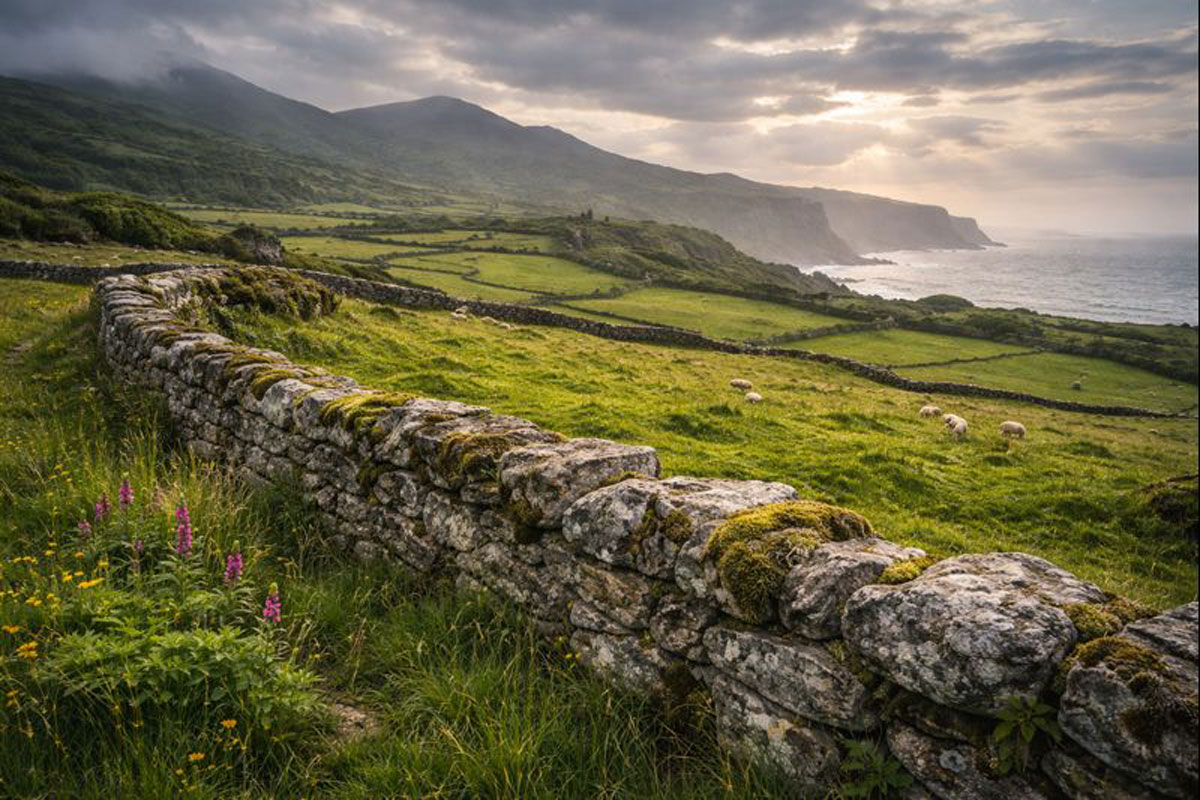
Across Ireland’s countryside, stone walls stretch over hills, fields, valleys, and coastlines, quietly shaping the land as much as rivers or mountains. These walls are not monuments in the traditional sense, yet they are among the most enduring features of the Irish landscape. Built by hand, stone by stone, they tell a story of survival, adaptation, and generations of quiet labour.
To travel through Ireland is to move through a land stitched together by stone. Whether crossing remote farmland, winding along coastal roads, or walking ancient paths, these walls form a constant presence—unassuming, weathered, and deeply woven into the country’s identity.
Table of Contents
- Part 1 – The Origins of Ireland’s Stone Walls
- Part 2 – Building Without Mortar: Skill, Balance, and Tradition
- Part 3 – Stone Walls and the Shape of the Land
- Part 4 – Life, Labour, and Survival in Stone
- Part 5 – Why Ireland’s Stone Walls Still Matter
The Origins of Ireland’s Stone Walls
Ireland’s stone walls have their roots in necessity rather than design. In many parts of the country, particularly in the west, the soil is thin and rocky. Stones had to be cleared from the land before crops could be grown or animals grazed. Rather than discarding them, people used what they had in abundance to create boundaries and shelter.
Over time, these practical solutions became defining features of the landscape. Walls marked land ownership, separated fields, protected crops from livestock, and offered shelter from Atlantic winds. Some date back hundreds of years, while others were built during periods of hardship, most notably during the 18th and 19th centuries.
In places like Connemara, the Burren, and the Aran Islands, stone walls form intricate patterns across the land, shaping fields that appear almost geometric when viewed from above. Each wall reflects the landscape it belongs to, adapting to slopes, curves, and natural obstacles.
Building Without Mortar: Skill, Balance, and Tradition
Many of Ireland’s stone walls were built without mortar, using a technique known as dry stone walling. This method relies entirely on careful placement, balance, and an understanding of weight and pressure. Each stone supports another, creating a structure that is both flexible and durable.
Dry stone walls are designed to move slightly with the land rather than resist it. This flexibility allows them to withstand strong winds, heavy rain, and even ground movement better than rigid structures. When built correctly, a dry stone wall can last for generations.
The skill required to build these walls was traditionally passed down through families and communities. Knowledge of which stones to choose, how to angle them, and how to lock them together came from experience rather than instruction manuals. Every wall reflects the hands that built it and the land that provided its materials.
Stone Walls and the Shape of the Land
Stone walls do more than divide land—they shape how the landscape is experienced. They guide the eye across fields, lead travellers along narrow roads, and frame views of hills, valleys, and coastlines. In many rural areas, roads feel enclosed by stone, creating a sense of passage through the land rather than across it.
These walls respond directly to their surroundings. In exposed coastal areas, they are often low and thick to withstand wind. In upland regions, they follow the contours of the hills, rising and falling with the terrain. In fertile farmland, they form orderly grids that reflect generations of cultivation.
Stone walls also create micro-environments. Moss, lichen, ferns, and wildflowers take root in the gaps between stones. Small animals shelter within them, and birds perch along their tops. Over time, walls become living structures, supporting biodiversity as well as boundaries.
Life, Labour, and Survival in Stone
Behind every stone wall lies a story of labour. Many were built during times of extreme hardship, when survival depended on making use of every available resource. In the aftermath of the Great Famine, stone walls became symbols of endurance, marking reclaimed land and hard-won subsistence.
Building these walls was physically demanding work. Stones were gathered by hand, carried across fields, and shaped through repeated lifting and placement. The work was often slow and relentless, carried out in harsh weather and difficult conditions.
Yet there is dignity in these structures. They represent persistence and adaptability, reflecting a deep understanding of the land. Stone walls were not built for beauty, yet their quiet presence and weathered appearance give them a powerful visual and emotional impact.
Why Ireland’s Stone Walls Still Matter
Today, Ireland’s stone walls remain an essential part of the countryside. Some are still maintained and repaired using traditional methods, while others are slowly reclaimed by nature. Together, they form an unbroken link between past and present.
Ireland’s Stone Walls by the Numbers
While they often fade into the background, Ireland’s stone walls form one of the most extensive hand-built features in the country. It is estimated that there are over 250,000 kilometres (155,000 miles) of stone walls across Ireland, stretching through farmland, hills, coastal landscapes, and remote rural regions.
The majority of these walls were constructed from the 18th century onward, particularly in areas where land was divided into small holdings and stones needed to be cleared from thin, rocky soil. In western regions such as Connemara, the Burren, and the Aran Islands, stone walls became essential for creating workable fields and protecting livestock from Atlantic winds.
Dry stone walling, the technique used to build many of these walls without mortar, is recognised by UNESCO as an Intangible Cultural Heritage craft. This recognition highlights the importance of the skill, knowledge, and tradition passed down through generations of rural communities.
Beyond their historical value, stone walls continue to play an environmental role. The gaps between stones provide shelter for insects, birds, small mammals, mosses, and lichens, making these walls important micro-habitats within Ireland’s countryside.
These walls connect modern Ireland to centuries of rural life, craftsmanship, and resilience. They remind visitors that the landscape was shaped not only by nature, but by human hands working in harmony with it.
To notice Ireland’s stone walls is to notice the quiet details that define the country. They are not dramatic landmarks or headline attractions, yet they are among the most authentic features of the Irish landscape. Built by hand, shaped by weather, and standing in silence, they tell a story that continues to unfold with every passing year.