



Table of Contents
- Introduction: A Medieval Jewel in Kilkenny
- The History of St. Canice’s Cathedral
- The Round Tower: A Rare Climb into the Past
- Architectural Features and Treasures Within
- Visiting Tips and What to Know Before You Go
A Medieval Jewel in Kilkenny
St. Canice’s Cathedral and its adjoining round tower stand as proud guardians of Kilkenny’s medieval past. Nestled at the northern end of the city, this breathtaking site is the second-largest medieval cathedral in Ireland, after St. Patrick’s in Dublin. Built in the 13th century on the site of a 6th-century monastic settlement founded by St. Canice himself, the cathedral is not only an active place of worship but also a living museum of Gothic grandeur and Irish heritage.
What sets St. Canice’s apart is not just its age or beauty, but its rare combination of architectural elegance and adventurous appeal. Visitors can not only admire the stunning stonework and stained glass but also physically climb into history via the freestanding round tower that predates the cathedral itself. From its summit, breathtaking views of Kilkenny city and the surrounding countryside await those willing to scale its ancient laddered interior.
The History of St. Canice’s Cathedral
The story of St. Canice’s Cathedral begins long before the current stone structure was laid. Its origins trace back to the 6th century when Saint Canice (also known as Cainnech of Aghaboe), one of Ireland’s early Christian monks, established a monastery on this very site. The area grew into a major ecclesiastical center, attracting scholars, clergy, and pilgrims alike. Although the original wooden church is long gone, the site remained spiritually and politically important for centuries.
Construction of the present-day Gothic cathedral began around 1251 and continued into the early 14th century. Built of local limestone, the structure reflects the strength and beauty of Gothic design, with features like pointed arches, ribbed vaults, and flying buttresses. Unlike many other medieval cathedrals, St. Canice’s has remained remarkably intact through the centuries, surviving wars, reformations, and neglect.
After the English Reformation, the cathedral was transferred to the Church of Ireland, and although it lost some of its Catholic rituals and relics, it continued to be maintained and used for worship. Today, it still serves as the cathedral for the Diocese of Cashel, Ferns, and Ossory. Over the centuries, restoration efforts have helped preserve its medieval character while allowing visitors to explore its story-rich interior.
The surrounding cathedral close once housed a school, a bishop’s palace, and other ecclesiastical buildings. Many of these structures are now in ruins or have been repurposed, but their layout offers a sense of how central this religious site was to the life of medieval Kilkenny. Together with the adjacent round tower, St. Canice’s Cathedral represents a rare continuity of Irish Christian history from the earliest monastic days through to the present.
The Round Tower: A Rare Climb into the Past
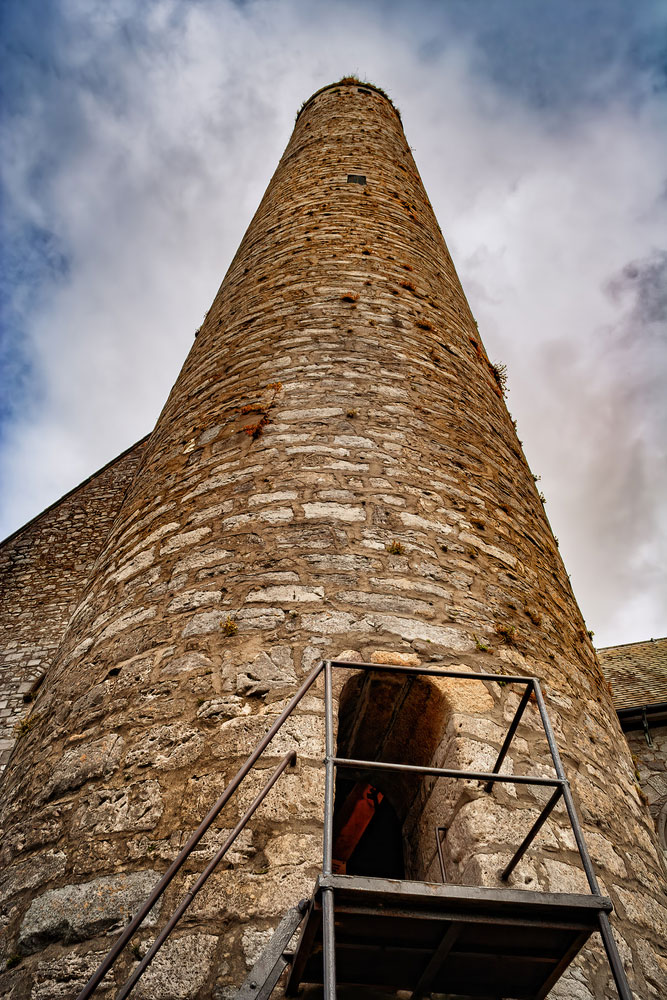
Standing beside the cathedral like a silent sentry is the Round Tower of St. Canice’s, one of the oldest surviving structures in Kilkenny. Believed to have been constructed in the 9th century, this freestanding tower predates the Gothic cathedral by more than 300 years. It was originally built as part of the early Christian monastic site and served multiple purposes: as a bell tower, a lookout post, and a place of refuge during Viking or tribal raids.
The tower stands nearly 100 feet (30 meters) tall and is one of only a handful in Ireland that are still accessible to the public. Climbing it is not for the faint of heart—visitors ascend via a series of steep internal ladders and wooden steps, emerging at the top for an unforgettable panoramic view of Kilkenny’s rooftops, the River Nore, the surrounding countryside, and even the Blackstairs Mountains on a clear day.
Its construction is a marvel of early medieval engineering. Built without mortar in the lower sections, the stones are perfectly shaped to hold each other in place. The entrance sits well above ground level—a defensive feature—and there are multiple small windows set at different levels, aligned with the cardinal directions. The top has been reconstructed with a conical cap, preserving the traditional appearance of Ireland’s round towers.
For historians and thrill-seekers alike, the experience of physically climbing an authentic 9th-century tower is extraordinary. It offers not only a literal ascent but a metaphorical one—a climb through centuries of Irish ecclesiastical and architectural history. Few places in Ireland offer such a direct connection to the early medieval church, and fewer still let you climb it.
Architectural Features and Treasures Within
St. Canice’s Cathedral is a masterwork of Irish Gothic architecture, with its limestone walls, soaring arches, and long nave creating a solemn and graceful atmosphere. Measuring over 200 feet in length, the cathedral retains much of its original medieval layout and detailing, which is rare among Irish ecclesiastical buildings. The structure includes a nave, choir, transepts, and a central tower, all typical of Gothic design, but with distinctly Irish flourishes.
One of the most striking interior features is the stained glass, much of which dates to the 19th century, illuminating the cathedral with vibrant biblical scenes. Look for windows by renowned Irish artists such as Catherine O’Brien and Wilhelmina Geddes, whose work reflects the Celtic Revival movement. Equally notable are the stone carvings, including grotesques and angels, which adorn arches and columns throughout the nave.
Visitors will also encounter a wealth of medieval tombs and effigies. These include the richly carved 14th-century tomb of Bishop Ledred—who is best known for presiding over the infamous trial of Alice Kyteler, accused of witchcraft in nearby Kilkenny. Other tombs feature knights in full armor and nobles in prayer, offering a hauntingly beautiful glimpse into the cathedral’s role as a burial site for the city’s elite.
The cathedral’s Bishop’s Throne and elaborately carved pulpit are also worth noting, as is the cathedral organ, a magnificent 20th-century instrument that echoes through the ancient stone with concert-quality acoustics. The floor is partially composed of medieval tiles, and a walk around the perimeter reveals various chapels, memorials, and alcoves filled with centuries of ecclesiastical history.
Outside, the cathedral close and graveyard feature ancient Celtic crosses, headstones with carved skulls and hourglasses, and remnants of vanished buildings, each adding another layer to the story of this sacred place. Whether you come for prayer, reflection, or curiosity, St. Canice’s interior rewards every visitor with beauty, mystery, and a palpable sense of the past.
Visiting Tips and What to Know Before You Go
St. Canice’s Cathedral and Round Tower is one of Kilkenny’s top heritage attractions, drawing history lovers, architecture buffs, and spiritual seekers alike. Whether you’re planning a full day of exploring the city or a short cultural stop, here are some key tips to make the most of your visit.
Getting There
The cathedral is located in the Irishtown area of Kilkenny, a short walk from the medieval mile and the city center. Kilkenny is well-connected by train and bus from Dublin and other major cities. Paid parking is available nearby, but walking from your accommodation may be easiest during peak times.
Opening Hours and Entry
The site is typically open from March through October, Monday to Saturday, with reduced hours in winter months. Entry includes access to both the cathedral and the round tower, though the tower may close in bad weather for safety reasons. Tickets are available at the door or online.
Climbing the Round Tower
The round tower climb is exhilarating but requires a reasonable level of fitness and mobility. The narrow ladders and steep steps are not suitable for young children or anyone uncomfortable with heights. Wear comfortable footwear and take your time—there’s no rush to the top!
What to Bring
- Camera: The view from the round tower is spectacular and worth capturing.
- Guidebook or Audio Guide: Available at the entrance for a deeper experience.
- Respectful Attire: As it is an active place of worship, modest dress is appreciated.
Nearby Attractions
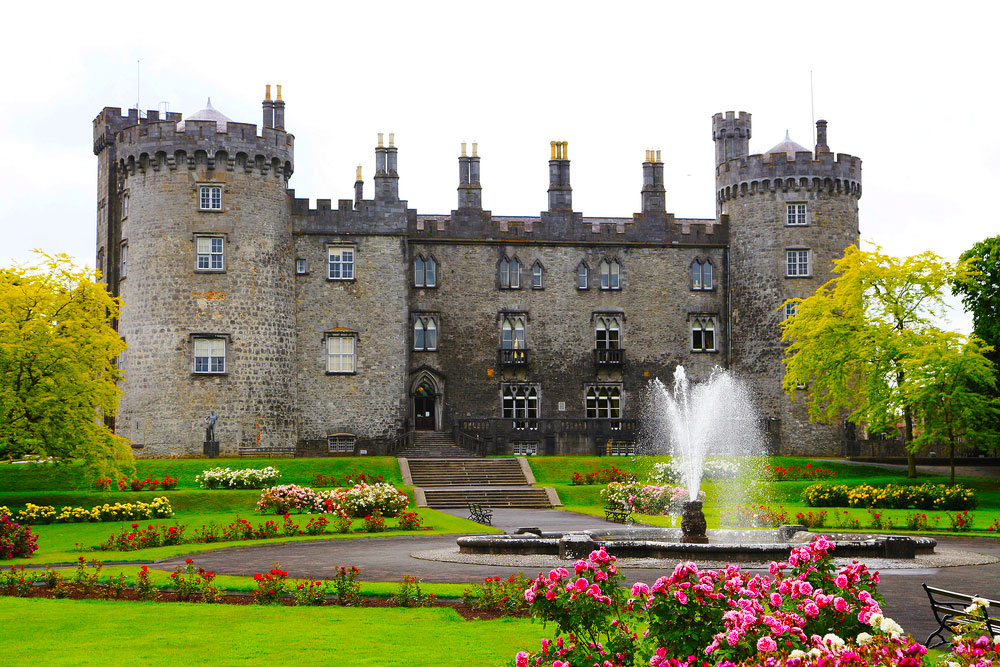
Don’t miss the other highlights of Kilkenny while you’re here. Visit Kilkenny Castle, stroll the Medieval Mile, explore the Black Abbey, or enjoy local food at one of the city’s many artisan cafés and pubs. A visit to St. Canice’s pairs well with a full day of cultural immersion.
Whether you’re climbing the tower, admiring stained glass, or tracing your hand along weathered stone, St. Canice’s Cathedral offers a memorable experience that blends Ireland’s ancient roots with its medieval magnificence. It’s not just a stop on a map—it’s a journey into the heart of Irish history.