



Ireland’s most famous attractions are famous for a reason. The Cliffs of Moher are spectacular, the Ring of Kerry offers extraordinary scenery, and places such as the Giant’s Causeway and Glendalough deserve their reputations. For a first-time visitor, many of these landmarks are absolutely worth seeing, and there is no reason to avoid a place simply because it has become popular.
However, popularity can change the experience. Arrive at one of Ireland’s best-known attractions on a busy summer afternoon and you may encounter tour buses, crowded car parks, queues, and viewpoints filled with other visitors. For some travelers, that is simply part of visiting a famous destination, while others may find themselves wishing for somewhere that offers the same sense of natural beauty, history, or atmosphere with a little more room to explore.
Fortunately, Ireland is filled with quieter landscapes and historic places that receive only a fraction of the attention given to its headline attractions. These destinations are not necessarily replacements for the famous places, nor are they lesser versions of them. Instead, they offer their own scenery, character, and stories, often in surroundings where it is easier to slow down and appreciate where you are.
If you enjoy discovering places beyond the busiest tourist routes, the following destinations offer some wonderful alternatives to Ireland’s best-known attractions. You may still want to visit the famous sights, but adding one or two of these quieter places can reveal a very different side of Ireland.
Table of Contents
- Instead of the Cliffs of Moher: Loop Head
- Instead of the Ring of Kerry: The Beara Peninsula
- Instead of Glendalough: The Glen of Aherlow
- Instead of the Giant’s Causeway: Fair Head
- Instead of Killarney National Park: Gougane Barra
- Instead of Blarney Castle: Cahir Castle
- Instead of the Dingle Peninsula: The Sheep’s Head Peninsula
- Why Quieter Ireland Can Be So Rewarding
Instead of the Cliffs of Moher: Loop Head
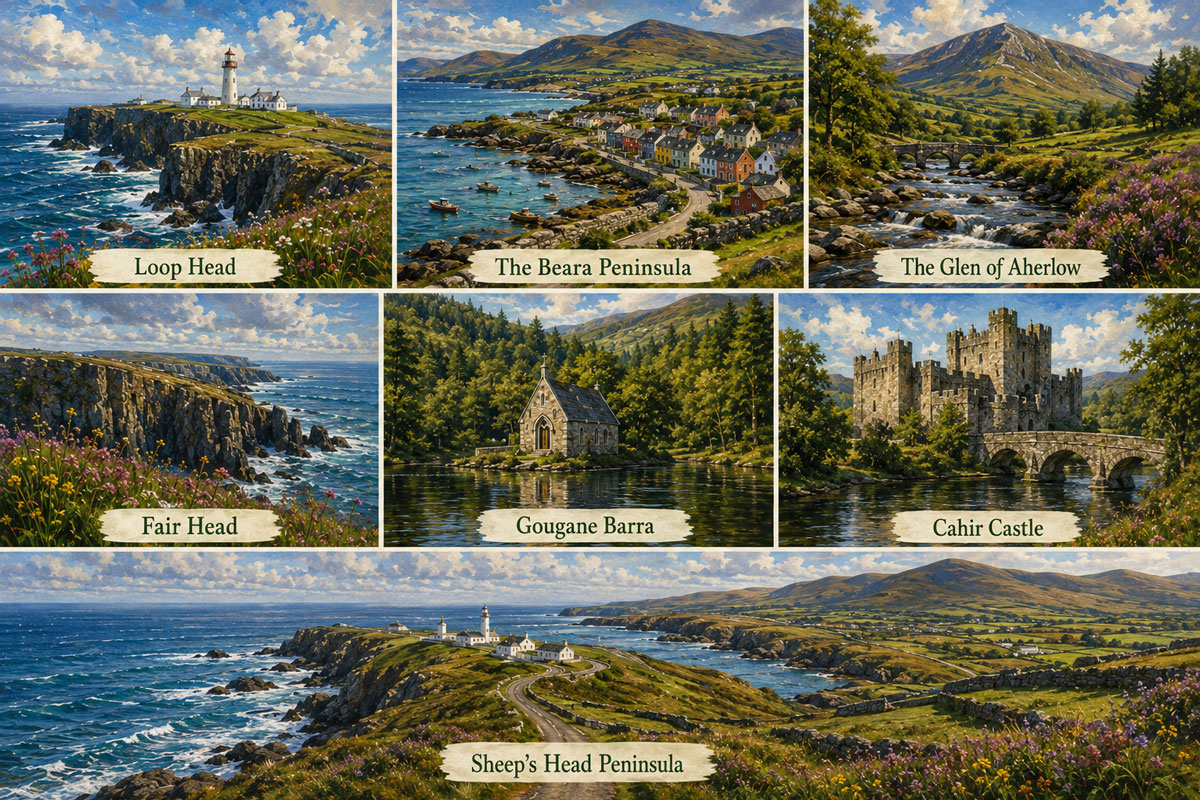
The Cliffs of Moher are among Ireland’s great natural landmarks. Rising dramatically above the Atlantic in County Clare, they are understandably included on countless first-time itineraries. But Clare’s coastline does not end there, and travelers willing to continue southwest will eventually reach the Loop Head Peninsula, where towering cliffs, crashing Atlantic waves, seabirds, small villages, and windswept landscapes create a much quieter coastal experience.
Loop Head feels considerably more remote than the Cliffs of Moher. Instead of arriving at a large visitor complex, you travel through open countryside toward a narrow peninsula extending into the Atlantic. At its western end stands Loop Head Lighthouse, surrounded by dramatic coastal scenery, while walks in the area provide wonderful views and a genuine sense of being on Ireland’s western edge.
The Cliffs of Moher remain well worth seeing, particularly on a first visit to Ireland. But if what attracts you most is the wild Atlantic landscape rather than the fame of the destination, Loop Head deserves serious consideration. It offers cliffs, ocean views, and the windswept character of County Clare in surroundings where it is often much easier to slow down and simply enjoy the scenery.
Instead of the Ring of Kerry: The Beara Peninsula
The Ring of Kerry is one of Ireland’s classic scenic drives, combining mountains, lakes, Atlantic coastline, beaches, and picturesque villages along one of the country’s most celebrated touring routes. It deserves its reputation, but during the busiest months its popularity can also mean tour buses, busy viewpoints, and considerable traffic. Travelers searching for similar southwestern scenery at a quieter pace should look toward the Beara Peninsula.
Shared between Counties Cork and Kerry, Beara offers many of the qualities that draw visitors to this corner of Ireland. Rugged mountains descend toward the sea, narrow roads twist around the coastline, and fishing harbors and colorful villages appear between stretches of remarkably wild countryside. Villages such as Allihies and Eyeries are worth taking time to explore, while the peninsula’s remote roads provide some magnificent Atlantic views.
Beara is particularly suited to travelers who enjoy taking their time rather than following a tightly scheduled sightseeing route. Stop in the villages, explore the coastline, take an unexpected turn, or simply find somewhere to enjoy the view. The Ring of Kerry may have greater international name recognition, but the Beara Peninsula offers something that can be just as memorable: the feeling that you have discovered a quieter corner of southwestern Ireland for yourself.
Instead of Glendalough: The Glen of Aherlow
Glendalough is one of Ireland’s most atmospheric destinations, combining an ancient monastic settlement with lakes, forests, and the surrounding Wicklow Mountains. Its location within easy reach of Dublin also makes it one of the most popular countryside excursions in eastern Ireland. Those interested primarily in peaceful valleys, mountain scenery, and walking trails may find a very different but equally rewarding experience in County Tipperary’s Glen of Aherlow.
The Glen of Aherlow lies between the Galtee Mountains and the wooded Slievenamuck ridge, creating a broad valley filled with farmland, forests, mountain views, and walking routes. The area has a distinctly rural character, and its location away from Ireland’s busiest tourism corridors helps preserve a sense of tranquility. Scenic viewpoints across the valley reveal a landscape that feels expansive and surprisingly removed from the better-known attractions of southern Ireland.
The experience is not identical to Glendalough, particularly because Aherlow does not have the famous round tower and extensive monastic remains that make the Wicklow site so historically important. What it does offer is space for walking and exploring without the same concentration of visitors. For travelers who simply want to spend a few hours surrounded by Irish mountain scenery, the Glen of Aherlow can be a wonderful discovery.
Instead of the Giant’s Causeway: Fair Head
The Giant’s Causeway is one of Northern Ireland’s most recognizable natural attractions. Its extraordinary basalt columns were created by ancient volcanic activity, resulting in a landscape unlike almost anywhere else in Ireland. There is no true substitute for the Causeway itself, but travelers whose main interest is experiencing the drama of County Antrim’s northern coastline have another remarkable option nearby.
Fair Head rises above the sea near Ballycastle and provides sweeping views across a rugged landscape of cliffs, open fields, stone walls, and Atlantic water. On particularly clear days, it is possible to see toward Scotland across the North Channel. Walkers and climbers have long appreciated the area, but it remains far removed from the large-scale visitor infrastructure and crowds associated with the Giant’s Causeway.
There is also no reason travelers have to choose one or the other. The Giant’s Causeway can be visited early in the morning or later in the day, leaving time to explore quieter parts of the Antrim coast. Combining a famous landmark with somewhere such as Fair Head can provide the best of both experiences: one of Ireland’s great natural wonders alongside the spaciousness of a much less crowded coastal landscape.
Instead of Killarney National Park: Gougane Barra
Killarney National Park is one of Ireland’s finest natural destinations, encompassing mountains, lakes, forests, waterfalls, historic estates, and some of County Kerry’s most recognizable scenery. There is enough to explore there for several days, but its location beside one of Ireland’s busiest tourism towns means visitors rarely have the area entirely to themselves. For something much smaller and more intimate, travel into the mountains of West Cork to Gougane Barra.
Gougane Barra sits in a secluded valley surrounded by forested hills, with a peaceful lake at its center. On a small island near the water stands St. Finbarr’s Oratory, a tiny stone church whose setting has made it one of the area’s most recognizable sights. Nearby, Gougane Barra Forest Park offers woodland walks beneath tall trees and through a landscape that can feel remarkably isolated, particularly outside the busiest summer periods.
Gougane Barra cannot match Killarney National Park for sheer size or variety, but that is part of its attraction. A misty morning beside the lake or a quiet walk through the forest provides a more contemplative experience than a day spent moving between major attractions. For travelers who value atmosphere and tranquility as much as spectacular scenery, Gougane Barra is one of West Cork’s most rewarding places to discover.
Instead of Blarney Castle: Cahir Castle
Blarney Castle is one of Ireland’s best-known castles, thanks largely to the centuries-old tradition surrounding the Blarney Stone. Visitors arrive from around the world to climb the castle and take part in the famous ritual of kissing the stone, and the surrounding gardens make it an enjoyable stop in County Cork. Travelers primarily interested in medieval architecture, however, may prefer a different castle experience in nearby County Tipperary.
Cahir Castle occupies a dramatic position on a rocky island in the River Suir and is among Ireland’s most impressive surviving medieval fortresses. Its towers, defensive walls, courtyards, and thick stone fortifications provide a vivid sense of how imposing such a castle would once have appeared. The riverside setting adds considerably to its character, while the surrounding town is compact enough to explore on foot.
A visit to Cahir can also be combined with other attractions in the area. The picturesque Swiss Cottage is nearby, while the Rock of Cashel is within easy reach and provides another extraordinary glimpse into Ireland’s medieval past. Cahir certainly attracts visitors and should not be considered undiscovered, but it generally offers a different atmosphere from internationally famous Blarney and is an excellent choice for travelers particularly interested in Irish history.
Instead of the Dingle Peninsula: The Sheep’s Head Peninsula
The Dingle Peninsula is one of the great destinations of western Ireland. Its combination of mountains, Atlantic coastline, archaeological sites, traditional culture, and the lively town of Dingle makes it understandably popular. Travelers searching for the quietness and isolation associated with Ireland’s remote peninsulas, however, should consider heading farther south into West Cork.
The Sheep’s Head Peninsula stretches between Bantry Bay and Dunmanus Bay and remains considerably less developed for tourism than many of Ireland’s famous coastal regions. Narrow roads pass scattered farms, rocky shores, small communities, and hillsides overlooking the water. There are fewer major attractions demanding your attention, which encourages visitors to appreciate the landscape itself rather than rush from one scheduled stop to another.
Walkers can explore sections of the Sheep’s Head Way, while the journey toward Sheep’s Head Lighthouse takes visitors deeper into the peninsula’s remote scenery. This is not the place to come looking for a bustling tourism town filled with shops and nightlife. Instead, Sheep’s Head offers the chance to walk, stop beside the coast, listen to the wind coming off the Atlantic, and experience just how peaceful rural Ireland can still be.
Why Quieter Ireland Can Be So Rewarding
Choosing quieter destinations does not mean avoiding Ireland’s famous places altogether. If you have dreamed of standing at the Cliffs of Moher, you should see them, and if the Giant’s Causeway has been on your travel list for years, there is little reason to miss it. Ireland’s celebrated attractions became famous because they offer something genuinely remarkable, and many deserve a place on a first-time itinerary.
The mistake is allowing those famous places to become your entire experience of the country. For every celebrated scenic drive, castle, national park, or coastal viewpoint, there are other landscapes that receive only a fraction of the attention. Exploring them provides more opportunities to stop spontaneously, walk without crowds, visit smaller communities, and experience parts of Ireland where tourism plays a less dominant role in everyday life.
Quieter destinations also encourage a slower style of travel. You might spend longer over lunch in a village because there is no attraction you need to reach by a particular time, follow a coastal trail farther than expected, or change your plans after someone in a café recommends a place you had never heard of. These unscheduled moments often become some of the experiences travelers remember most clearly after returning home.
Ireland’s famous places can provide some of the photographs you came hoping to take, but its quieter corners often provide the stories you end up telling. The best trip does not necessarily require choosing between the two. By combining Ireland’s celebrated landmarks with a few less-traveled destinations, you can experience both the iconic Ireland you came to see and the quieter Ireland you may not have expected to find.