



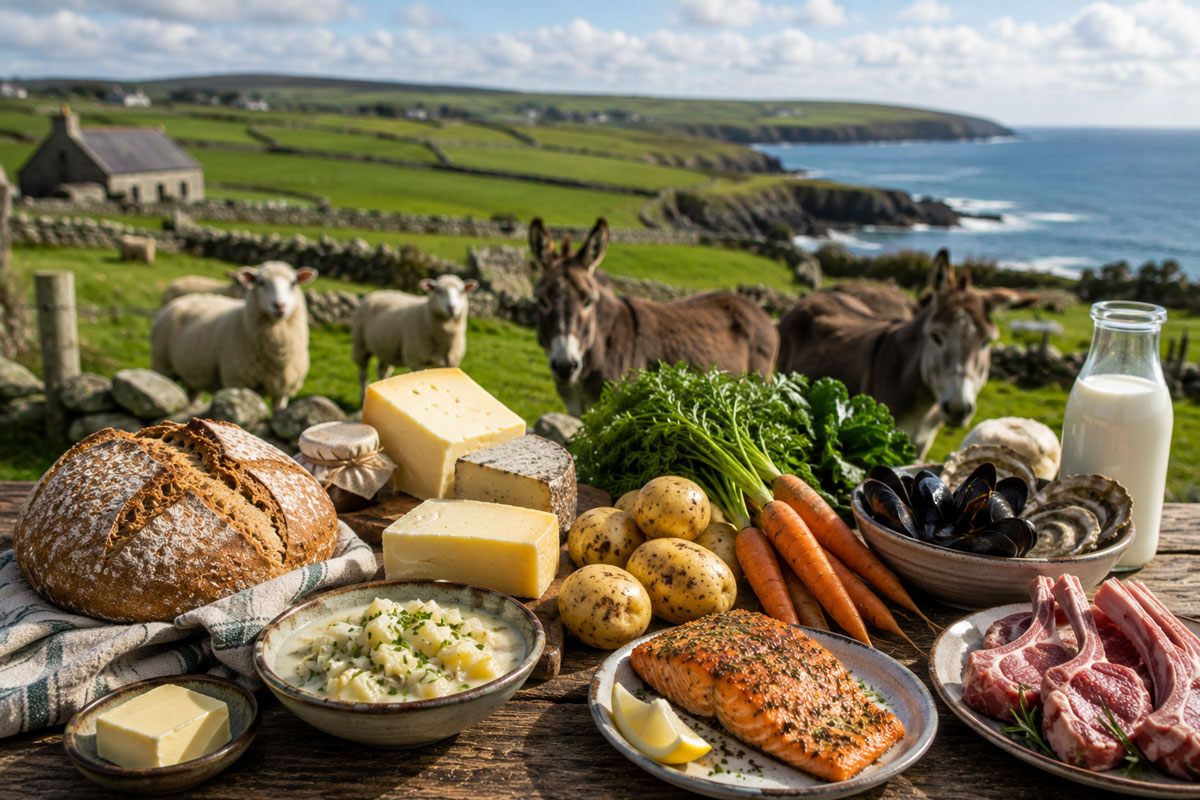
Irish food is deeply connected to the land. From rugged Atlantic coastlines to rolling green pastures and fertile inland valleys, the landscapes of Ireland have shaped not only what people eat, but how food has been grown, prepared, and shared for generations.
Many of Ireland’s best-known foods exist because of the country’s geography and climate. Rich grasslands support dairy farming, cold Atlantic waters provide seafood, and rocky hillsides encourage hardy traditional crops and livestock.
To understand Irish cuisine, it helps to first understand the landscapes behind it. Across the country, local environments continue to influence regional specialties, seasonal ingredients, and long-standing food traditions.
Table of Contents
- Green Pastures and Ireland’s Dairy Tradition
- The Atlantic Coast and Ireland’s Seafood Culture
- Fertile Farmland and Traditional Crops
- Mountains, Sheep Farming, and Regional Flavors
- A Climate That Shapes Seasonal Cooking
Green Pastures and Ireland’s Dairy Tradition
Few landscapes are more closely associated with Ireland than its rolling green fields. Frequent rainfall and mild temperatures create ideal grazing conditions, allowing grass to grow for much of the year.
This landscape has made dairy farming one of Ireland’s most important agricultural traditions. Grass-fed cows produce milk that is rich and creamy, contributing to the distinctive flavor of Irish butter, cheese, and cream.
Irish butter, known for its deep golden color and high butterfat content, reflects the richness of the grasslands the cows graze on. Many traditional Irish dishes—from soda bread to mashed potatoes—rely heavily on quality dairy products.
Even today, the countryside remains filled with small farms and grazing cattle, preserving a connection between the land and the food produced from it.
The Atlantic Coast and Ireland’s Seafood Culture
Surrounded by the Atlantic Ocean and the Irish Sea, Ireland has long depended on coastal waters for food. Fishing communities developed around the country’s rugged coastline, creating traditions centered on fresh seafood.
Cold Atlantic waters support a wide variety of fish and shellfish, including salmon, mackerel, cod, oysters, mussels, and crab. Coastal counties such as Galway, Cork, Kerry, and Donegal remain especially known for seafood dishes.
In many parts of Ireland, seafood traditions were shaped by necessity as much as geography. Coastal communities relied on what could be caught locally, leading to recipes built around fresh and simple ingredients.
Today, seafood chowders, smoked salmon, and shellfish platters continue to reflect the influence of Ireland’s coastal landscapes.
Fertile Farmland and Traditional Crops
Beyond the coast and pastures, Ireland’s fertile farmland has shaped generations of cooking traditions. Potatoes became one of the country’s defining crops after being introduced in the 16th century, eventually becoming a staple food across Ireland.
The potato adapted well to Ireland’s damp climate and could grow even in difficult conditions. Over time, it became central to dishes such as colcannon, boxty, champ, and traditional Irish stew.
Root vegetables like carrots, parsnips, onions, and turnips also thrive in Ireland’s climate and remain important ingredients in traditional cooking.
In many rural areas, family gardens and small farms historically supplied much of a household’s food. This close connection between people and the land helped create a food culture built around seasonal, locally grown ingredients.
Mountains, Sheep Farming, and Regional Flavors
Ireland’s mountainous and rocky regions have also influenced its food traditions. In areas where the land was less suited to crops, sheep farming became more common.
Connemara, Kerry, and parts of Donegal are especially associated with lamb and mutton dishes. Sheep grazing on wild grasses and coastal herbs often develop flavors unique to their environment.
Connemara lamb, for example, is known for its distinctive taste shaped by the rugged western landscape and salty Atlantic air.
Mountain regions also encouraged simple, hearty cooking traditions designed to provide warmth and nourishment during colder months. Stews, soups, and baked breads became staples of rural life.
A Climate That Shapes Seasonal Cooking
Ireland’s climate has always played a major role in shaping how food is prepared and preserved. Long winters and wet weather encouraged methods such as smoking, curing, fermenting, and baking.
Seasonality remains an important part of Irish cooking traditions. Spring lamb, summer berries, autumn root vegetables, and winter comfort foods all reflect the changing rhythm of the landscape.
For centuries, families relied on preserving food to survive colder months. Salted butter, cured fish, jams, and baked goods helped extend ingredients beyond their harvest season.
Even modern Irish cuisine often emphasizes fresh, seasonal ingredients sourced from local farms, fisheries, and artisan producers.
How the Irish Landscape Continues to Influence Food Today
While Irish food has evolved over time, the landscape still shapes much of what appears on the table. Restaurants across Ireland increasingly celebrate regional ingredients and traditional farming methods, reconnecting modern cooking with local environments.
Travelers exploring Ireland can often taste the difference from one region to another. Coastal towns emphasize seafood, rural counties highlight dairy and lamb, and fertile inland areas continue to produce fresh vegetables and grains.
This close relationship between landscape and cuisine gives Irish food a strong sense of place. The flavors are not only shaped by recipes, but by the fields, coastlines, rivers, and mountains where the ingredients originate.
In Ireland, food is more than nourishment—it is part of the story of the land itself.