



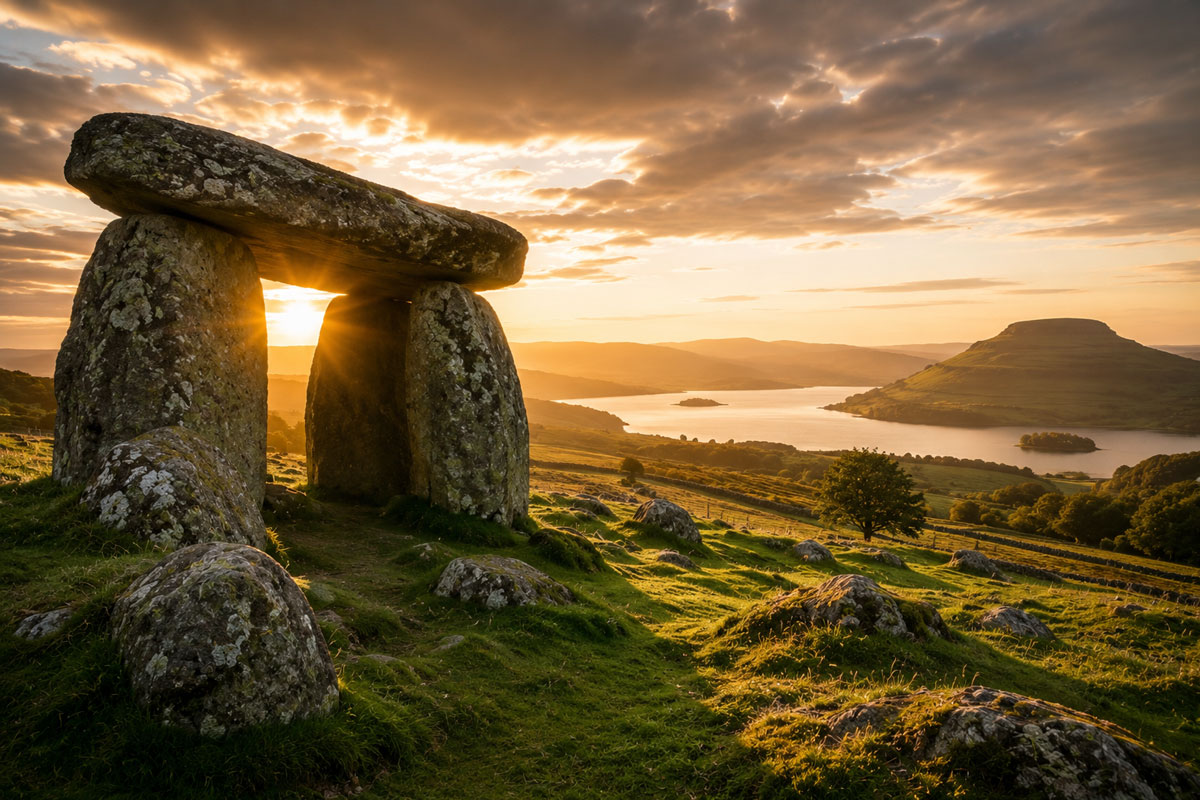
In Ireland, the landscape is more than just scenery—it is a living record of myth, legend, and belief. Hills, rivers, lakes, and mountains are not only shaped by nature, but by stories passed down through generations. In many places, the land itself is said to hold the memory of ancient gods, heroes, and supernatural events.
Unlike in many parts of the world, where mythology exists separately from geography, Irish myths are deeply tied to specific locations. These stories were not simply told—they were placed into the land, giving meaning to natural features and turning them into landmarks of cultural memory.
This connection between myth and place is one of the most unique aspects of Ireland’s heritage, where every hill or valley may carry a story waiting to be discovered.
Table of Contents
- Hill of Tara – Seat of Kings and the Otherworld
- Giant’s Causeway – The Path of Giants
- Lough Neagh – A Giant’s Mistake
- Benbulben – The Tragic Hunt of Diarmuid
- Newgrange – Light, Myth, and the Otherworld
Hill of Tara – Seat of Kings and the Otherworld
The Hill of Tara in County Meath is one of Ireland’s most important historical and mythological sites. Known as the ancient seat of the High Kings of Ireland, Tara is also deeply connected to the Tuatha Dé Danann—the mythical race said to have ruled Ireland before the arrival of humans.
According to legend, Tara was not just a political center but a gateway to the Otherworld, a mystical realm that existed alongside the human world. The Lia Fáil, or Stone of Destiny, is said to roar when touched by the rightful king of Ireland, linking the physical landscape to divine authority.
The rolling hills and earthworks at Tara may appear quiet today, but they are layered with centuries of meaning. Walking here is less about dramatic scenery and more about standing in a place where myth, power, and identity were once believed to meet.
Giant’s Causeway – The Path of Giants
One of Ireland’s most famous natural wonders, the Giant’s Causeway in County Antrim is also one of its most legendary. The unique hexagonal basalt columns that stretch into the sea are explained in science as the result of volcanic activity—but in Irish folklore, they were built by a giant.
The story tells of Finn McCool (Fionn mac Cumhaill), a legendary warrior who constructed the causeway as a bridge to Scotland to challenge a rival giant. When he realized the size of his opponent, Finn disguised himself as a baby. Seeing the “child,” the rival giant imagined the father must be enormous and fled in fear, destroying the causeway behind him.
This playful yet powerful legend transforms a geological formation into a story of wit and survival. Even today, the shapes of the stones are said to resemble parts of the giant’s path, keeping the story alive in the landscape itself.
Lough Neagh – A Giant’s Mistake
Lough Neagh, the largest freshwater lake in Ireland, is also tied to the legend of Finn McCool. According to the story, Finn scooped up a massive piece of earth to throw at a rival. The chunk of land missed its target and fell into the sea, becoming the Isle of Man. The hole left behind filled with water, forming Lough Neagh.
This myth provides a dramatic explanation for the lake’s vast size and shape, linking it directly to the actions of a legendary figure. It’s a reminder of how Irish mythology often uses storytelling to make sense of the natural world.
Today, Lough Neagh is a peaceful and expansive body of water, but its origin story adds a layer of imagination that transforms how the landscape is perceived.
Benbulben – The Tragic Hunt of Diarmuid
Benbulben, with its distinctive flat-topped shape, is one of the most recognizable mountains in Ireland. Located in County Sligo, it is closely tied to the Fenian Cycle of Irish mythology.
The mountain is associated with the story of Diarmuid Ua Duibhne, a warrior of the Fianna. According to legend, Diarmuid was cursed to die by a boar. While hunting on the slopes of Benbulben, he was fatally wounded by the very creature he was destined to encounter.
The story adds a sense of tragedy and inevitability to the landscape. Benbulben is not just a mountain—it becomes the setting for one of Ireland’s most poignant mythological moments.
Today, the mountain stands as both a natural landmark and a reminder of the stories that shaped Ireland’s cultural identity.
Newgrange – Light, Myth, and the Otherworld
Older than the pyramids of Egypt, Newgrange in County Meath is one of Ireland’s most mysterious sites. This ancient passage tomb is aligned with the rising sun during the winter solstice, when light illuminates its inner chamber.
In Irish mythology, Newgrange is associated with the Tuatha Dé Danann and is believed to be an entrance to the Otherworld. It is also linked to the story of the god Dagda and his son Aengus, who tricked his father into giving him the site for “a day and a night”—which he interpreted as eternity.
The alignment of the tomb with the sun adds to its mystical significance, blending ancient engineering with spiritual meaning. It is a place where myth, astronomy, and landscape come together in a way that continues to fascinate visitors.
Where Myth and Landscape Become One
What makes Ireland unique is not just the presence of myths, but how deeply they are embedded in the land. These stories were not created in isolation—they were shaped by the landscapes people lived in and passed down through generations.
Mountains became the homes of heroes, lakes were formed by giants, and ancient sites were seen as gateways to other realms. Over time, these stories gave meaning to the land, turning ordinary places into something extraordinary.
For travelers, this means that exploring Ireland is not just about seeing beautiful locations—it’s about experiencing a landscape where every feature may carry a story.
Whether standing on the Hill of Tara, walking along the Giant’s Causeway, or watching the light enter Newgrange, visitors are stepping into a world where myth and reality have always existed side by side.