



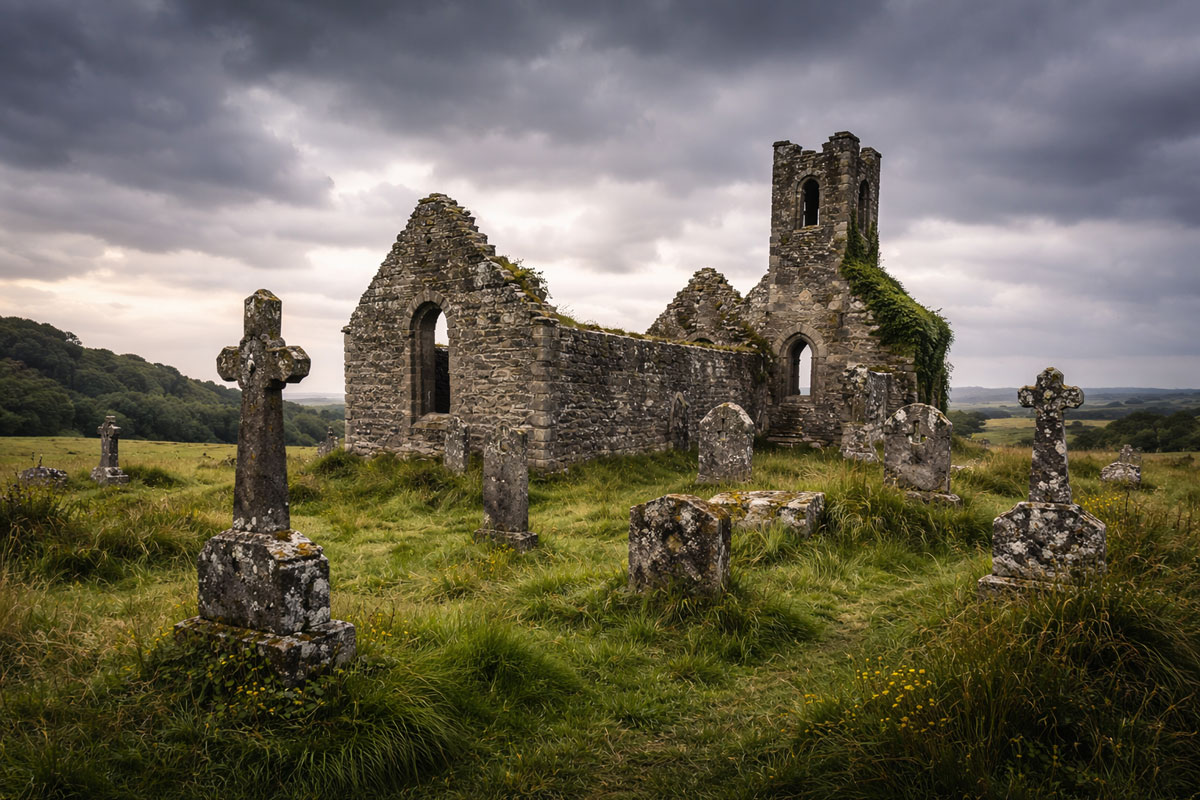
Scattered across Ireland’s countryside are the remains of churches long abandoned but never forgotten. Roofless, weathered, and open to the sky, these ruined churches are among the country’s most atmospheric and quietly powerful places. Unlike grand cathedrals or ticketed heritage sites, many of them can still be entered freely, allowing visitors to step inside centuries of history at their own pace.
These ruins are not fenced off or polished for display. They exist as they are—stone walls softened by moss, worn thresholds shaped by countless footsteps, and silence broken only by wind and birdsong. To wander into one of Ireland’s ruined churches is to encounter the past in its most honest form.
Table of Contents
- Part 1 – Sacred Spaces Left to Time
- Part 2 – Why So Many Churches Fell Into Ruin
- Part 3 – Architecture, Graves, and Quiet Details
- Part 4 – Ruined Churches in the Irish Landscape
- Part 5 – Visiting With Respect and Care
Sacred Spaces Left to Time
Many of Ireland’s ruined churches date from the early medieval period through to the 17th century. Once active centres of worship, learning, and community life, they gradually fell out of use as populations shifted, parishes merged, or new churches were built nearby.
What remains today is often a shell of stone—thick walls, arched doorways, and window openings that frame sky instead of glass. These buildings no longer function as churches in the traditional sense, yet they retain a strong sense of reverence. Time has stripped them of ornament and ritual, leaving behind something raw and deeply moving.
Unlike preserved heritage sites, these ruins invite quiet exploration. There are no ropes or guided paths. Visitors are free to wander, pause, and reflect, experiencing the space much as it stands—open, weathered, and still.
Why So Many Churches Fell Into Ruin
The reasons behind Ireland’s abundance of ruined churches are rooted in history rather than neglect. Religious upheaval, changing political power, and shifting settlement patterns all played a role in their abandonment.
During the Reformation and subsequent centuries, many religious buildings changed hands, fell out of use, or were deliberately dismantled. Later, rural depopulation and famine reduced congregations, making it impossible to maintain multiple churches within small communities.
In many cases, new churches were built nearby using different materials or architectural styles, leaving older structures behind. Rather than being demolished, these earlier buildings were simply left to the elements, gradually returning to the landscape they once served.
Architecture, Graves, and Quiet Details
Though roofless, Ireland’s ruined churches still reveal remarkable craftsmanship. Thick stone walls, finely cut arches, and traces of carved decoration speak to the skill of their builders. Some structures are simple and austere, while others hint at former grandeur through ornate doorways or sculpted stonework.
Graveyards often surround these churches, containing headstones that span centuries. Names repeat across generations, linking families to the same sacred ground over hundreds of years. Weathered inscriptions, Celtic crosses, and simple markers contribute to the sense of continuity between past and present.
Small details reward slow exploration: a stone niche worn smooth by touch, a window aligned with the rising sun, or ivy tracing patterns across ancient masonry. These elements give each ruin its own quiet personality.
Ruined Churches in the Irish Landscape
One of the most striking aspects of Ireland’s ruined churches is their setting. Many stand alone in fields, beside rivers, or overlooking coastlines, placed where faith once met daily life. Their locations were rarely accidental; they were built where communities gathered, travelled, and settled.
Over time, nature has reclaimed these sites. Grass grows within their walls, trees lean nearby, and wildlife moves freely through doorways once reserved for worshippers. In mist or rain, these ruins feel especially powerful, their stones darkened and softened by weather.
The absence of roofs allows light, cloud, and sky to become part of the experience. Standing within a ruined church, visitors are both sheltered and exposed—connected to the land as much as to history.
Visiting With Respect and Care
While many ruined churches in Ireland are open and accessible, they remain places of significance. Visitors are encouraged to approach them with care and respect, remembering that these sites once served as centres of faith, ceremony, and community.
Graveyards should be treated thoughtfully, and climbing on fragile structures should be avoided. Preservation depends largely on quiet stewardship, allowing these ruins to endure without unnecessary disturbance.
To wander freely through Ireland’s ruined churches is to step into spaces shaped by belief, time, and resilience. They may no longer echo with prayer, but they offer something just as meaningful—a chance to reflect, to slow down, and to experience Ireland’s past in a way that feels personal and unguarded.
Ruined Churches You Can Wander Freely Across Ireland
While ruined churches can be found in every corner of Ireland, some sites are particularly well known for their atmosphere, setting, and sense of openness. The following examples offer a glimpse into the variety of ruined churches you may encounter, each reflecting a different aspect of Ireland’s religious and cultural past.
- Mellifont Abbey – County Louth
Ireland’s first Cistercian monastery, set in a peaceful river valley. Though partially restored, the surrounding ruins and grounds remain open and contemplative. - Jerpoint Abbey – County Kilkenny
Renowned for its detailed stone carvings and roofless cloister, offering an intimate look at medieval monastic life. - Boyle Abbey – County Roscommon
A striking example of early Cistercian architecture, standing quietly near the River Boyle and open to the elements. - Devenish Island – County Fermanagh
Accessible by boat, this island monastery combines ruined churches, a round tower, and sweeping lake views. - Sligo Abbey – County Sligo
A Dominican friary ruin in the heart of Sligo town, where carved stonework and open arches frame the sky. - Ardfert Cathedral – County Kerry
A group of roofless medieval church ruins set within a quiet graveyard, rich in architectural detail. - Nendrum Monastic Site – County Down
A serene early Christian site overlooking Strangford Lough, where low stone walls and open space create a powerful sense of calm.
This list is far from complete. Part of the experience of Ireland’s ruined churches lies in discovering them unexpectedly—down quiet roads, beside fields, or beyond small villages. Many remain unmarked and unstaffed, waiting to be encountered rather than announced.
Whether planned or stumbled upon, these sacred ruins invite a slower pace and a deeper connection to the land, offering moments of reflection that linger long after you leave.