


Wildness in Ireland isn’t only about dramatic cliffs or big mountains. It’s the feeling that the landscape still leads the day — that weather can change your plans, roads can narrow without warning, and silence can stretch for miles. In some places, the land feels carefully managed and easy to access. In others, you sense the edges of remoteness: fewer services, fewer people, and a slower rhythm that invites you to stop trying to “see everything” and simply experience where you are.
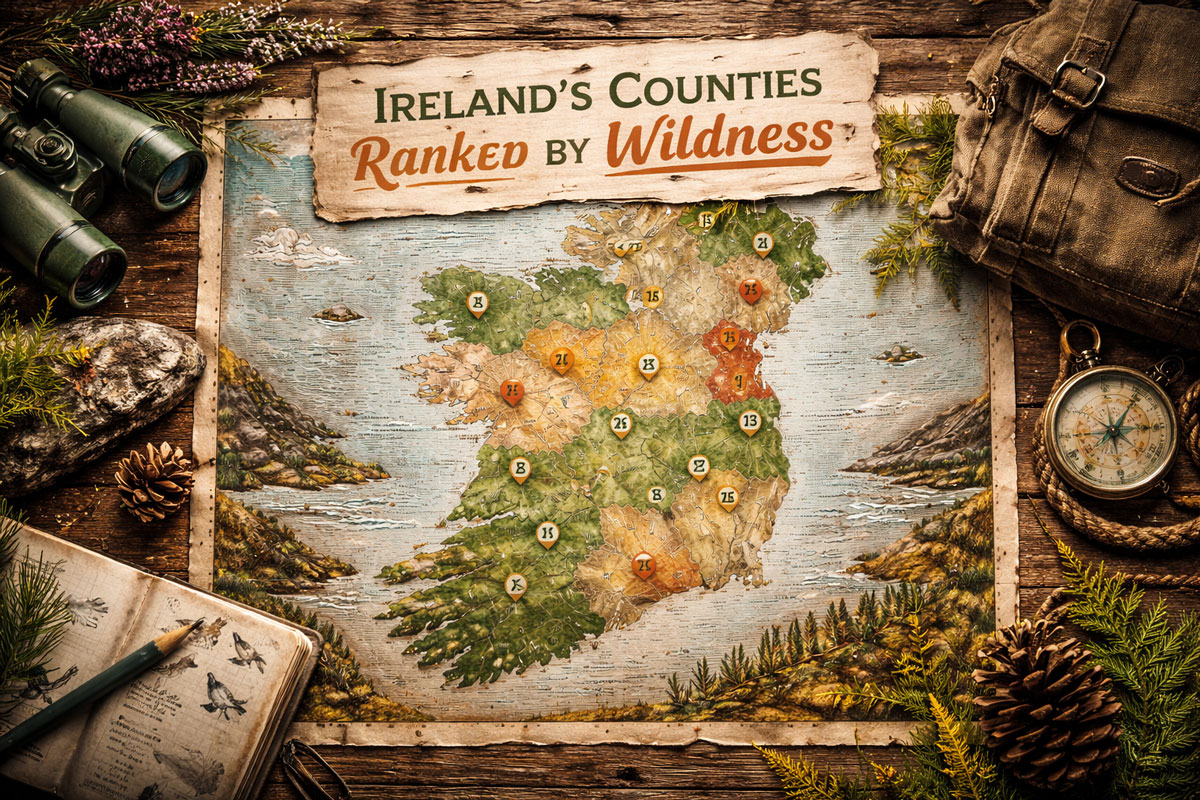
This ranking looks at Irish counties through a practical “wildness” lens. It blends scenery with what matters on the ground: distance, population density, infrastructure, and how easily you can step away from the modern pace. It’s not a judgment of which counties are “best” — it’s a guide to where you’re most likely to find that untamed, elemental Ireland many travelers hope for.
Table of Contents
- Part 1 – What “Wildness” Means in Ireland
- Part 2 – The 10 Wildest Counties (Ranked)
- Part 3 – Wild Coastal Counties vs. Wild Inland Counties
- Part 4 – How to Experience Wild Ireland Respectfully
- Part 5 – Quick Planning Tips for a Wilder Trip
- FAQ – Ireland’s Wildest Places
What “Wildness” Means in Ireland
Ireland’s wildness is different from the wilderness of larger countries. You won’t typically find huge national parks where you can hike for days without crossing a road. Instead, Irish wildness feels more intimate and more human-scaled — and that’s part of its power.
In Ireland, “wild” often means:
- Remoteness: Not far in miles, but far in time. Narrow roads, slower driving, and fewer direct routes make places feel truly distant.
- Low population density: Less housing, fewer towns, and long stretches of open land.
- Nature that still feels in charge: Weather shifts quickly, coastal winds reshape the experience, and visibility can change in minutes.
- Limited infrastructure: Fewer petrol stations, shops, cafes, or quick “pit stops” once you’re deep in rural areas.
- A sense of space and silence: The kind that makes you lower your voice without thinking.
This list leans toward counties where that feeling is easiest to find — whether you’re walking, hiking, driving quiet backroads, or simply spending a few unhurried days in a small village with the landscape at your doorstep.
The 10 Wildest Counties in Ireland (Ranked)
1) County Mayo
If you’re looking for Ireland’s closest thing to true wilderness, Mayo is a strong contender for the top spot. Vast boglands, remote inland roads, and Atlantic coastline create a sense of scale that’s rare in Ireland. Places like Wild Nephin (Ballycroy) and the wide open spaces around Achill and North Mayo feel quiet, raw, and wonderfully unpolished.
- Wildness highlights: Big skies, bogland emptiness, remote coastal stretches
- Best for: Travelers who want silence, space, and minimal tourist “packaging”
2) County Donegal
Donegal feels like a county at the edge of everything. Its remoteness from Ireland’s major cities gives it a distinct rhythm, and its landscapes are among the most rugged in the country. Wild peninsulas, empty beaches, and dramatic cliffs combine with weather that can turn gentle scenery into something fierce.
- Wildness highlights: Rugged coastline, lonely roads, powerful Atlantic exposure
- Best for: A raw, dramatic “end of the road” feeling
3) County Galway (Connemara)
Galway is a tale of two halves: the lively city and the wilder west. In Connemara, the landscape opens into boglands, lakes, and mountains that feel ancient and uncompromising. Once you’re beyond the main routes, the county’s wildness is not just scenic — it’s atmospheric.
- Wildness highlights: Connemara bogs, rugged hills, big weather
- Best for: Travelers who want wild landscapes with strong local culture nearby
4) County Kerry
Kerry is famously beautiful — but it still has a wild heart. Yes, parts of it are heavily toured, but step away from the busiest loops and you’ll find remote valleys, stormy coastlines, and peninsulas that feel like the land is still in charge. When the weather comes in, Kerry can feel genuinely elemental.
- Wildness highlights: Peninsulas, mountains, coastal exposure
- Best for: Wild scenery with iconic stops and plenty of lodging options
5) County Cork
Cork earns its place through sheer size and variety. While the city and east are more developed, West Cork can feel wonderfully remote. Long winding roads, quiet peninsulas, and stretches of coastline where you might walk for ages without passing more than a few people give Cork a strong wildness factor.
- Wildness highlights: West Cork peninsulas, quiet coastal roads
- Best for: A mix of wild stretches and charming villages
6) County Leitrim
Leitrim is often overlooked — and that’s part of its wildness. It’s not a county of famous cliffs or headline scenery, but it offers something rarer: quiet rural Ireland where time slows down. Lakes, hills, forests, and low-density countryside create a gentle, deep kind of wild.
- Wildness highlights: Rural quiet, woodland pockets, lakes and hills
- Best for: Travelers who want peace more than drama
7) County Sligo
Sligo is compact, but it delivers a strong wild feel in specific pockets — especially along the coast and around its bold mountain silhouettes. It’s the kind of county where you can go from lively town energy to exposed coastal quiet within a short drive.
- Wildness highlights: Mountain-and-sea contrast, moody landscapes
- Best for: Photogenic wildness without extreme remoteness
8) County Clare
Clare’s Atlantic edge is dramatic, and places like the Burren can feel otherworldly. But much of the county is accessible and well-traveled, so the wildness is concentrated rather than continuous. It’s more “wild at the edges” than “wild everywhere.”
- Wildness highlights: Burren landscapes, Atlantic coastline
- Best for: Wild scenery with easy access and strong tourist infrastructure
9) County Waterford
Waterford isn’t usually the first county people name when they think “wild Ireland,” but its coastline can be rugged and beautifully exposed. Inland, it softens into gentler countryside, making it a good choice for travelers who want moments of wildness without feeling too remote.
- Wildness highlights: Coastal walking, sea cliffs, breezy headlands
- Best for: A balanced trip with scenic wild stretches
10) County Wicklow
Wicklow’s mountains and valleys can feel surprisingly untamed — especially in mist, rain, or winter light. But proximity to Dublin reduces the sense of “beyond reach.” You’ll still find wild-feeling hikes and quiet corners, just not the deep remoteness of the Atlantic northwest.
- Wildness highlights: Mountain walks, forested valleys, moody weather
- Best for: A wild day trip or short escape without going far
Wild Coastal Counties vs. Wild Inland Counties
Not all wildness feels the same. Ireland’s coastal wildness is often dramatic — cliffs, wind, surf, and shifting light. Inland wildness is quieter — bogs, forests, lakes, and long stretches of rural road with little interruption.
What coastal wildness feels like
- Big views and exposed weather
- Rapidly changing light and skies
- Cliffs, beaches, headlands, and sea air
What inland wildness feels like
- Silence and stillness
- Wide open bogland and long empty roads
- Less “spectacle,” more atmosphere
If you want the most complete “Wild Ireland” experience, consider combining one coastal county (like Donegal or Kerry) with one inland-feeling area (like Mayo’s interior or Leitrim).
How to Experience Wild Ireland Respectfully
Wild places are often working landscapes. What looks “empty” may be farmland, commonage, or protected habitat. A few small habits go a long way toward keeping Ireland’s wild areas healthy and welcoming:
- Leave no trace: Pack out litter, even biodegradable scraps.
- Respect gates and boundaries: If a gate is closed, leave it closed. Don’t cross fences unless clearly permitted.
- Drive slowly and pull in safely: Rural roads are shared with tractors, cyclists, walkers, and animals.
- Support local life: Small shops, cafés, and pubs are part of the ecosystem of rural places.
- Plan for weather: Waterproof layers beat perfect forecasts.
Wildness is more enjoyable when you’re prepared — and when local communities feel respected rather than “overrun.”
Quick Planning Tips for a Wilder Trip
If your goal is to feel Ireland’s wild side, the best travel strategy is often the simplest: choose fewer bases, move slower, and leave space for weather and spontaneity.
- Stay longer in one place: Three nights in one rural base often feels wilder than rushing through five counties.
- Avoid only peak-season hotspots: Shoulder seasons (spring/fall) bring moody beauty and fewer crowds.
- Build “no-plan” mornings: Wildness appears when you stop chasing checklists.
- Bring offline maps: Signal drops are normal in remote areas.
- Choose walks over drives: Even short walks make a county feel bigger and quieter.
In the end, Ireland’s wildness isn’t just a location — it’s a pace. The more you slow down, the more the country reveals itself.
FAQ – Ireland’s Wildest Places
What is the wildest county in Ireland?
Many travelers argue for Mayo or Donegal. Mayo often feels like Ireland’s closest experience of true wilderness due to its large remote areas and quiet interior landscapes, while Donegal delivers rugged coastal drama and a strong sense of being at the edge of the country.
Which counties feel wild without being too remote?
Counties like Sligo, Clare, and Wicklow can offer strong wild moments — mountains, cliffs, moody coastlines — while still being relatively easy to access and plan.
Is Ireland safe for remote travel?
Generally yes, but the biggest risks are weather, narrow roads, and underestimating travel time. Drive carefully, check conditions, and plan fuel/food stops when traveling in very rural areas.
Can you experience Wild Ireland without a car?
Yes — especially by choosing one rural base village with local transport links and spending your days walking, cycling, using local taxis, or joining occasional small group tours. A slower, car-free week can actually deepen the sense of wildness.