

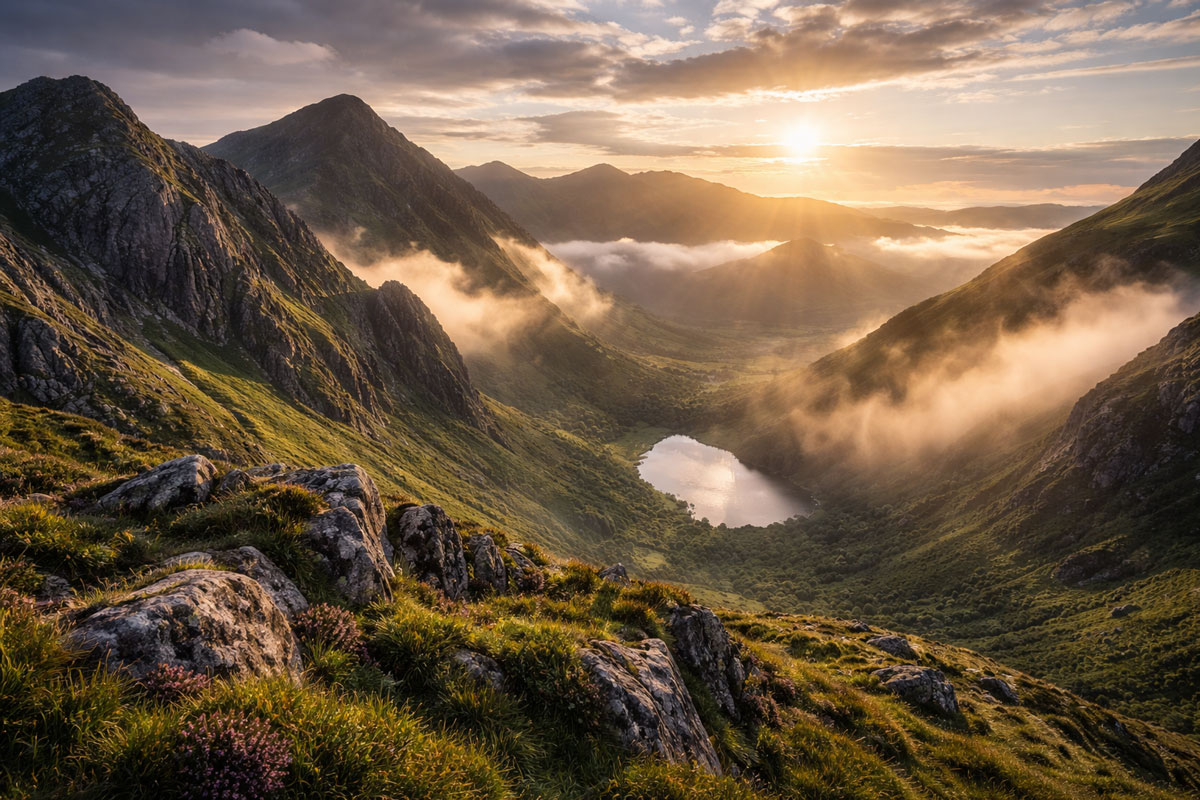
Ireland’s mountains are more than dramatic landscapes rising from green valleys and windswept coastlines. For centuries they have been places of myth, pilgrimage, and storytelling. Long before hiking trails and scenic drives brought visitors to their slopes, these mountains were woven into Ireland’s folklore, spiritual traditions, and heroic legends.
From sacred peaks associated with ancient gods to mountains linked with saints, giants, and warriors, many of Ireland’s most striking landscapes carry stories passed down through generations. Exploring Ireland’s mountains today often means stepping into a landscape where myth and geography exist side by side.
Table of Contents
- Croagh Patrick – The Holy Mountain of Ireland
- Benbulben – The Mountain of Warriors and Poetry
- Lugnaquilla – The Mountain of the Celtic God Lugh
- MacGillycuddy’s Reeks – Ireland’s Highest Mountains
- Carrauntoohil – Legends at the Roof of Ireland
Croagh Patrick – The Holy Mountain of Ireland
Rising dramatically above Clew Bay in County Mayo, Croagh Patrick is one of Ireland’s most sacred mountains. Known locally as “The Reek,” the mountain has been a place of pilgrimage for centuries and is closely associated with St. Patrick, Ireland’s patron saint.
According to tradition, St. Patrick fasted on the summit of Croagh Patrick for forty days and nights during the 5th century. During this time, legend says he battled dark forces and banished snakes from Ireland. Whether symbolic or historical, the story helped establish the mountain as a powerful spiritual site.
Each year on the last Sunday of July—known as Reek Sunday—thousands of pilgrims climb Croagh Patrick. Some complete the ascent barefoot as an act of devotion, following a tradition that stretches back generations.
But the mountain’s sacred history may go back even further than Christianity. Archaeological evidence suggests Croagh Patrick was already an important ritual site in prehistoric Ireland, possibly connected to ancient seasonal festivals and solar alignments.
Today, climbing Croagh Patrick offers not only stunning views across Clew Bay’s islands but also a powerful connection to centuries of Irish spiritual tradition.
Benbulben – The Mountain of Warriors and Poetry
Few mountains in Ireland are as instantly recognizable as Benbulben in County Sligo. Its flat-topped summit and steep cliffs make it one of the most distinctive landscapes in the country. The mountain is part of the Dartry Mountains and dominates the northern Sligo skyline.
Benbulben is deeply tied to Irish mythology and literature. In the Fenian Cycle of Irish legend, the mountain is linked to the warrior hero Diarmuid Ua Duibhne. According to the story, Diarmuid was fatally wounded by a magical boar on the slopes of Benbulben during a hunting expedition.
The mountain also holds literary significance thanks to the poet William Butler Yeats. Yeats was buried at nearby Drumcliff Churchyard beneath the shadow of Benbulben, and the mountain is referenced in several of his works.
Today, visitors can explore walking trails around Benbulben while taking in one of Ireland’s most iconic landscapes. The surrounding countryside, dotted with ancient tombs and stone monuments, adds to the sense that this is a place where history and myth blend together.
Lugnaquilla – The Mountain of the Celtic God Lugh
At 925 meters (3,035 feet), Lugnaquilla is the highest mountain in the Wicklow Mountains and the highest peak outside County Kerry. Its name comes from the Irish “Log na Coille,” often interpreted as “hollow of the wood.” However, some traditions link the mountain’s name to Lugh, a powerful god in Irish mythology associated with light, craftsmanship, and skill.
Lugh was one of the most important figures in Celtic mythology and is connected with the festival of Lughnasadh, an ancient harvest celebration that marked the beginning of the autumn season.
The Wicklow Mountains themselves have long been associated with ancient gatherings and seasonal celebrations. In early Irish society, hilltops and mountains were often used for assemblies, rituals, and territorial markers.
Even today, Lugnaquilla feels remote and mysterious. The mountain’s broad summit plateau, deep valleys, and shifting weather give the area a wild atmosphere that feels largely untouched by modern development.
Hikers who reach the summit are rewarded with sweeping views across Wicklow and on clear days as far as the Irish Sea.
MacGillycuddy’s Reeks – Ireland’s Highest Mountain Range
In County Kerry, the MacGillycuddy’s Reeks form Ireland’s highest mountain range. This dramatic chain of peaks stretches across the Iveragh Peninsula and includes several of the tallest mountains in the country.
The range takes its name from the MacGillycuddy clan, a powerful Gaelic family that once ruled this region. Their name translates roughly to “sons of the follower of St. Mochuda,” reflecting the blend of Gaelic and Christian influences that shaped Ireland’s history.
Beyond historical connections, the Reeks are also surrounded by folklore. Many Irish legends describe mountains as homes of supernatural beings, including the Tuatha Dé Danann, the mythical race of gods and heroes said to inhabit Ireland before the arrival of humans.
Stormy weather, mist-covered peaks, and hidden valleys have long encouraged stories about mysterious forces living within these mountains.
Today, the MacGillycuddy’s Reeks attract hikers and climbers from around the world who come to experience some of Ireland’s most dramatic alpine scenery.
Carrauntoohil – Legends at the Roof of Ireland
Standing at 1,038 meters (3,407 feet), Carrauntoohil is the highest mountain in Ireland. Its name comes from the Irish “Corrán Tuathail,” often translated as “Tuathal’s sickle” or “the sickle-shaped ridge.”
Carrauntoohil sits at the heart of the MacGillycuddy’s Reeks and has become one of Ireland’s most famous hiking destinations. Routes such as the Devil’s Ladder lead climbers through steep valleys and rocky slopes to the summit.
Like many Irish mountains, Carrauntoohil has its own share of folklore. Some local traditions connect the surrounding peaks with ancient giants and warriors, while others describe supernatural forces that once shaped the landscape.
Weather can change rapidly on the mountain, and thick mist often rolls across the summit. For centuries, such conditions added to the mystery of Ireland’s high places, reinforcing the belief that mountains were sacred or otherworldly locations.
At the summit today stands a large metal cross, first erected in the mid-20th century and later restored after storm damage. The cross reflects the mountain’s continuing role as both a natural landmark and a place of reflection.
Where Landscape and Legend Meet
Ireland’s mountains are among the country’s most powerful landscapes—not just for their beauty, but for the stories they carry. Each peak holds traces of ancient myth, spiritual tradition, or local legend that shaped how people understood the land around them.
For travelers exploring Ireland today, these mountains offer more than scenic views. They provide a glimpse into a cultural tradition where nature, storytelling, and belief have always been closely connected.
Whether climbing Croagh Patrick, walking beneath the cliffs of Benbulben, or gazing across the peaks of Kerry, visitors are stepping into landscapes where the echoes of Ireland’s legends still remain.