



Table of Contents
- Introduction: Ireland’s Medieval Fortress Monastery
- History of Kells Priory: From Foundation to Dissolution
- Exploring the Priory: Towers, Walls, and Sacred Spaces
- Visitor Information: How to Get There and What to Expect
- Heritage and Significance: Kells in the Irish Landscape
Ireland’s Medieval Fortress Monastery
On the tranquil banks of the King’s River in County Kilkenny lie the dramatic ruins of Kells Priory, one of Ireland’s most impressive medieval monastic complexes. Founded in the 12th century by the Augustinian Canons, the priory is remarkable not only for its vast scale but also for its defensive character. Known as the “Seven Castles” for its distinctive series of towers and enclosing walls, Kells looks more like a fortified town than a traditional monastery.
The site sprawls across three acres, with its walls and towers still dominating the surrounding countryside. Within, the remains of churches, domestic buildings, and cloisters speak of a once-thriving religious community. At the same time, the robust defenses tell of a world where monasteries needed protection from raids and unrest, making Kells a fascinating blend of sacred devotion and military architecture.
Today, Kells Priory is a place of quiet beauty. Sheep graze among the ruins, the towers stand sentinel over grassy fields, and the river flows gently past. The combination of scale, history, and atmosphere makes Kells one of the most rewarding monastic sites to explore in Ireland, and yet it remains a relatively peaceful, uncrowded destination compared to more famous abbeys.
For those tracing Ireland’s medieval past, Kells Priory offers an evocative glimpse into the religious, social, and political life of the Middle Ages. Its towers and walls may be weathered, but they still tell the story of centuries of faith, conflict, and resilience.
History of Kells Priory: From Foundation to Dissolution
Kells Priory was founded around 1193 by Geoffrey FitzRobert, a powerful Norman lord, who granted the site to the Augustinian Canons Regular. Dedicated to St. Mary, the priory quickly became one of the largest and wealthiest religious houses in medieval Ireland. Its location along the King’s River placed it in fertile land, while its proximity to Kilkenny city tied it into the wider network of Norman settlement and ecclesiastical power.
The priory’s history was not one of peace alone. In the late Middle Ages, Ireland was marked by conflict between Gaelic Irish and Norman settlers, and monasteries were not immune to raids or political upheaval. To protect the community, a series of defensive towers and walls were built around the priory in the 15th century, earning it the nickname “the Seven Castles of Kells.” These fortifications gave the monastery a unique appearance, more akin to a fortress than a spiritual retreat.
Like other religious houses in Ireland, Kells Priory suffered decline during the Dissolution of the Monasteries under Henry VIII in the 16th century. The Augustinian community was disbanded, its lands seized, and its buildings gradually fell into ruin. Over the centuries, locals reused stone from the priory for farm buildings, while the surviving towers and walls weathered into the landscape.
Despite centuries of decay, Kells retains much of its medieval character. The combination of monastic remains and fortified enclosures provides valuable insight into how religious life adapted to the realities of medieval Ireland. Today, the ruins stand as both a monument to Augustinian devotion and a testament to the turbulent history of Norman Ireland.
Exploring the Priory: Towers, Walls, and Sacred Spaces
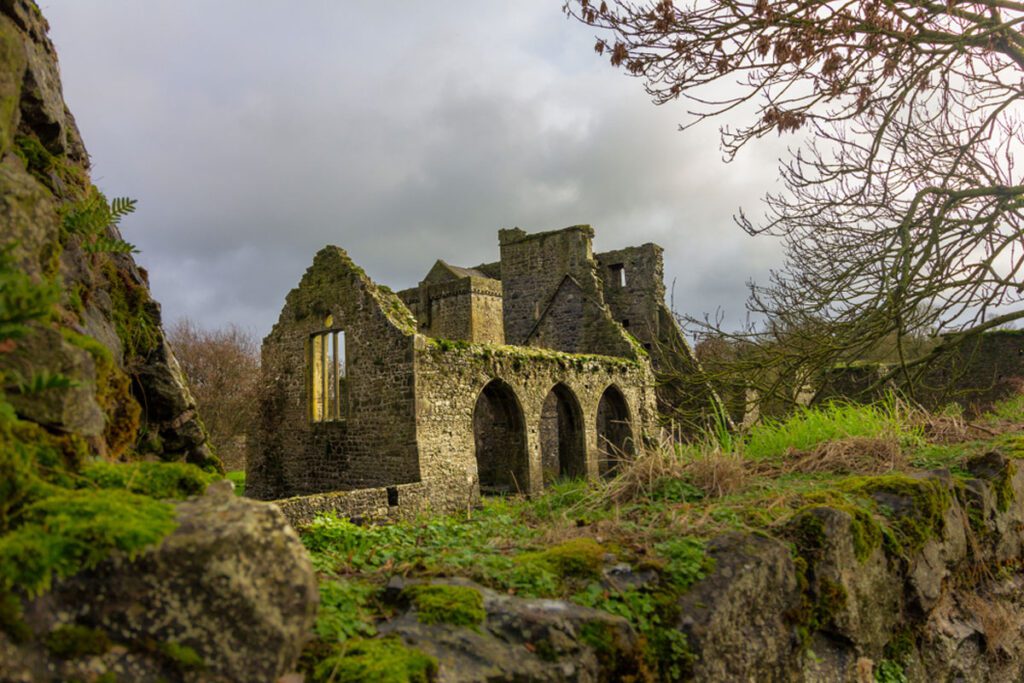
One of the most striking features of Kells Priory is its scale. Covering nearly three acres, the site is enclosed by an extensive circuit of defensive walls punctuated by a series of towers. These give the ruins their distinctive fortress-like appearance and have earned the site its popular name, the “Seven Castles.” Walking through the priory today, visitors can still trace the outlines of this fortified enclosure and imagine the blend of monastic devotion and military preparedness that defined life here.
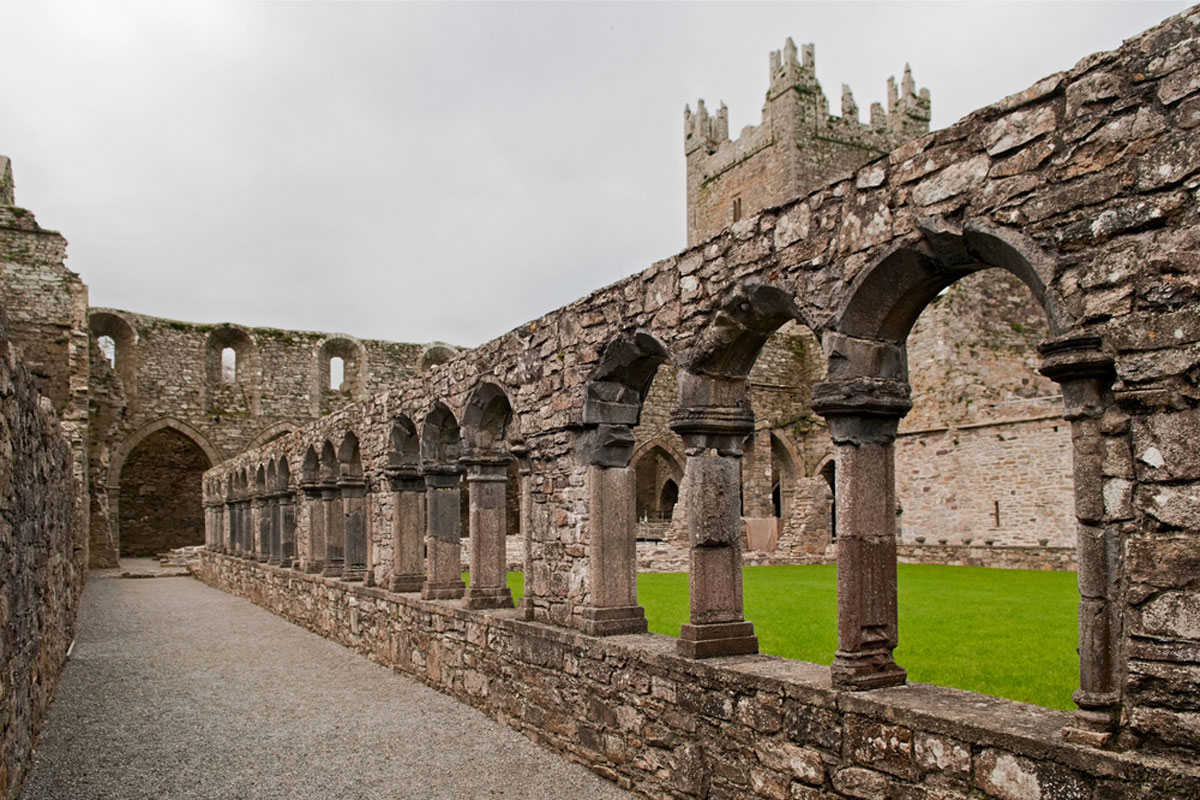
Within the walls lie the remains of the priory’s religious and domestic buildings. The church, though roofless, retains its soaring walls and windows that hint at the grandeur of the medieval structure. Around it are the foundations of cloisters, chapter houses, kitchens, and dormitories, each space once vital to the rhythm of Augustinian life. The combination of sacred and everyday buildings illustrates how the priory functioned as both a place of worship and a self-sufficient community.
Visitors can also explore the distinctive towers that line the walls. Some were defensive in purpose, while others served as gateways or watchpoints. Their presence is unusual in a monastic context and sets Kells apart from other Augustinian sites in Ireland. Together, they give the priory an unmistakable silhouette against the rolling fields of Kilkenny.
The atmosphere of the site is one of quiet drama. Sheep often graze in the grass around the ruins, while the King’s River flows gently by. The open fields allow unobstructed views of the walls and towers, and the sense of scale can be appreciated from every angle. Unlike more heavily visited sites, Kells retains a sense of peace and authenticity, inviting exploration at a leisurely pace.
For photographers and history enthusiasts alike, the combination of medieval stonework, defensive architecture, and pastoral setting makes Kells Priory one of the most rewarding monastic ruins in Ireland to explore.
Visitor Information: How to Get There and What to Expect
Visiting Kells Priory is a rewarding experience thanks to its accessibility and tranquil setting. The priory lies just outside the village of Kells, about 15 km south of Kilkenny city and 6 km from the heritage town of Callan. The site is well signposted from local roads, and a small parking area is available close to the entrance. From there, a short walk brings visitors directly into the heart of the ruins.
Admission is free, and the site is under the care of the Office of Public Works (OPW). Paths and grassy tracks allow easy access around the enclosure, though sturdy shoes are recommended, especially after wet weather. Information panels provide historical context, but the atmosphere of the site is best appreciated by wandering through the towers, walls, and open fields at your own pace.
There are no facilities such as cafés or toilets on site, but the nearby villages of Kells and Callan offer shops, pubs, and services. For a fuller day trip, visitors can combine Kells Priory with other Kilkenny attractions, such as Jerpoint Abbey, Kilkenny Castle, and the medieval streets of Kilkenny city. The scenic countryside of south Kilkenny also makes the area ideal for walking and cycling.
Because the ruins are spread across open ground, the site retains a sense of quiet seclusion. Unlike some heavily visited heritage attractions, Kells Priory often feels uncrowded, giving visitors the rare chance to enjoy one of Ireland’s largest medieval monasteries in peace. Early morning or late afternoon visits are especially atmospheric, as sunlight plays across the towers and surrounding fields.
Whether as a short stop on a heritage tour or as the focus of a leisurely afternoon, Kells Priory offers a unique combination of accessibility, scale, and authenticity that makes it a highlight of County Kilkenny’s historic landscape.
Heritage and Significance: Kells in the Irish Landscape
Kells Priory is more than a striking set of ruins — it is a monument to the ways in which faith, politics, and community life intersected in medieval Ireland. As one of the largest Augustinian houses in the country, it played a central role in the spiritual and social fabric of south Kilkenny for centuries. Its fortified walls remind us that monasteries were not isolated from the conflicts of their time, but rather deeply entwined with the fortunes of Norman lords and local communities.
In heritage terms, Kells stands out for its scale and preservation. Few other Irish monasteries display such an extensive system of towers and defensive walls, giving the site a unique character. Alongside nearby Jerpoint Abbey and Kilkenny’s medieval core, it forms part of a wider network of sites that showcase the richness of Ireland’s ecclesiastical heritage.
Today, the priory’s open, unspoiled setting enhances its appeal. The King’s River flows gently beside the walls, sheep graze in the fields, and the towers rise quietly against the sky. This combination of natural beauty and historic architecture makes Kells a place where the past feels tangible yet peaceful, accessible yet still evocative of another age.
For historians and visitors alike, Kells Priory embodies the resilience of Ireland’s medieval heritage. Its ruins continue to inspire reflection on the balance between devotion and defense, community and conflict. In the rolling landscape of County Kilkenny, it remains one of the most atmospheric reminders of Ireland’s monastic tradition.